Saturday, 23 November 2013

When Music Critiques Itself

I love the song Royals by New Zealand singer Lorde. It is full of irony and wonderfully tongue in cheek.  As commentary on the state of mainstream music, it is pure brilliance in a language contemporary youth culture has forgotten.  Fun without substance has been the rhetoric of choice in pop music.  First with Adele, and now with Lorde, the steady infiltration of the singer/ songwriter back into the mainstream is apparent.  Those of us with the ears to hear are breathing a sigh of relief at what appears to be a light at the end of the tunnel for pop music. 

Royals appears to have caused an awakening from the self-congratulatory, pseudo-empowerment party/break-up songs of the past 10 or so years.  The song’s commentary on the self-indulgent and irreverent state of the pop music genre contains enough irony to get people thinking, without feeling scrutinized.
Nowadays, making direct statements about the whether or not someone has done their job well is reserved for Politics.  Rock critic Henry Owings had this to say about blogs as the emerging music criticism forums:
“My biggest gripe with online journos is their false sense of importance when they're oftentimes just regurgitating press releases and tour dates. Of course, that mindless mentality is what many labels love. Me? I just find there to be a negligible amount of talent in what passes as a blogger in this modern age. What ever happened to attitude? What ever happened to opinions? What happened to pissing off advertisers? What happened to alienating readers? What happened to having fun? Sadly, I believe that the new boss is the same as the old boss. I just wish and pray somebody would be out there stirring things up instead of following the herd of mindless sheep. But then again, when you have publicists that just needle you all day to write about their clients, it makes a blogger's job easy.”
Harsh words, but he has a point, which you can read in its entirety here.   

Unencumbered by the limits of print media, bloggers have a unique opportunity to be the most candid with the state of mainstream music, but generally remain addicted to status quo reportage. In his article Fragments of a Sociology of Rock Criticism, rock critic Simon Firth talks about the kind of “arrogance to pass judgment on a record, a thickness of skin to proclaim one’s views in print (Jones 244).”  He also describes the trend of critiquing the artist’s persona above the music as detrimental to sound music criticism (Jones 244).  Persona has widely usurped adventurous creativity and refined musicality in mainstream music. 

Any artist who critiques another are attacked, mainly by the new genre of gossip media and, pseudo-stalker fans, “stans.”  A “stan” is a term taken from the Eminem song of the same name, for a fan who follows celebrity so closely through social media, it is borderline cyber stalking.  These types are vehemently protective and defensive toward any criticism aimed at their favourite celebrities.  As a term it implies it’s okay to be stalked as long as via the Internet.  That such as a body of people exists is the perhaps the biggest indication how far we have strayed from constructive art criticism across disciplines.  Even Lorde recently came under fire for her comments about fellow pop singers Taylor Swift and Miley Cyrus (whose fans actually sent out death threats to Lorde). 
This all illustrates the decline of criticism lamented by Clement Greenburg has not been limited to art.  Unabashed criticism in music has been scarce arguably since the late nineties at the peak of Bubblegum pop, Boy bands and Girl Power.  I think what many thought would be a brief reprieve from the overt melancholy and aggression that characterized Grunge and Rap music of the mid-nineties, turned into a 15 minutes too euphoric to let pass.  With the murders of Rap icons Biggie Smalls and Tupac, and the suicide of Nirvana lead, Kurt Cobain.  It seems audiences were ready for something less…. heavy.  Although, it was a tense period for mainstream music, there was contemplative defiance about culture that is gradually resurrecting.
Perhaps this because much like Rock criticism, Pop criticism is too undervalued. But audiences have always been responsive to socially conscious Pop music. This fact is widely demonstrated in the growth of Rock and Folk in the sixties and 70s and most recently the rise of Hip Hop culture. However, the more entrenched in commercialization an art form becomes the more difficult is to return to it's core values.  That is why all art needs criticism.  Jones talks about the uphill battle he faced early in his career, for Rock criticism to be viewed as relevant and credible as a part of Arts criticism (Jones 236-239).  Here is a great article on why music criticism is important, in spite of the resistance of some mainstream artists.
This is what makes Lorde and Royals so refreshing.  The song’s self-criticism brings pop music back to earth.  A voice of their own, Lorde calls out her generation for their materialistic aspirations. She subtly reaffirms that you don’t need celebrity for importance.  The lifestyle of everyday is more relevant then the irreverent opulence that media and other entertainers push in our faces.  Perhaps Lorde represents a shift we have all have been waiting for, of the beginnings of a mainstream artist community where iron truly sharpens iron.  Perhaps we’ll begin to see more artists become more considerate of the impact their music has not just on popular culture, but on music as an art form.  Maybe artist ego will finally move out of the way so music can take a look in the mirror and fix itself up a bit.  Music centered music, what a novel idea.

Sunday, 17 November 2013

Interdisciplinary Performing Arts


Interdisciplinary art in the performing arts is becoming increasingly popular Performance art has always utilized art forms from other disciplines but I think there is even more interest in creating the most multifaceted experience through integrating the arts.  What comes to mind is the Gesamkunstwerk or “the total work of art” as articulated by German composer Richard Wagner.  His medium was music and his platform was Opera.  Gesamkunstwerk is the pinnacle of experiential entertainment where the elements of a production are so seamlessly integrated that it results in the audience’s complete emotional immersion and subsequent connection to the work and story.  Opera is a great venue for all the to transpire, since the primary story is told by combining theatre and music. To my mind, the Metropolitan Opera’s most recent production of the Wagnarian opera trilogy The Ring Cycle is good example of  Gesamkunstwerk. The staged production includes digital effects, animation, and puppetry, all of which enhanced the audience experience of the story.
 Official Trailer for Wagner's Ring Cycle
(Metropolitan Opera, 2013) 

Many musicians and entertainers of contemporary genres create their concert tours in the spirit of the total work of art.  Although, not really a fan of the music, I find the work of pop singer Lady Gaga particularly interesting. She's put a lot of thought and artistic knowledge and understanding behind her persona. The presentation of her work is Gesamkunstwerk in to pop music. She created the Haus of Gaga to act as a creative think-tank to help create cohesion between her music, image, and shows.  Here's her take on it:


Haus of Gaga has part in every aspect of Lady Gaga’s stage persona. They develop interpretations of Lady Gaga’s artistic concepts across disciplines like hair, make-up, and costume design, sculpture, digital media, and dance.  


Celebrated contemporary artist, Jeff Koons, designed her most recent album cover. Check out Koons talking about their collaboration for the Artpop album below.

The visual elements throughout the experience are a crucial consideration of performance art.  Visual art manifests imagination in such a way that we can wholly embrace the truth of what we see, or challenge it head-on.  In creating the setting, this power informs the colour schemes, the style of application of the medium, the action, colour, and intensity of lighting.  The music should conjure the visual elements that give shape to the environment, and the most of all the feeling.  
Music not only provides inspiration, but it is often the catalyst for other artistic creations.  Dance is probably the most obvious example.  When hearing a new song, movement comes first, through tapping a foot or finger, or nodding the head to the rhythm.  Music enters our bodies and cycles out through singing or dance.  
When speaking of the visual arts, the best dancers seem to dance as if every movement they make, is to transform the body into a kind of sculpture if even for a split second.  I believe lines are integral to dance.  I think of the dancing body as a series of moving lines meeting, expanding and intersecting to the whims of the music and rhythm.

Here is Martha Graham's powerful choreography "Lamentation."   She talks about the inspiration of the piece and how it was interpreted through the costume and it's use as a prop within the work.  She follows this with the story's affect on one audience member who was deeply moved by the performance.

In life, a variety of external influences affects and inspires us.  We build our lives through these experiences, which empowers and evolves us as individuals and cultures.  The dynamic nature of interdisciplinary performing arts practices interprets and translates elements of one into another creating a broader artistic experience, a total work of art.
At the core of all this is the story.  How does the story move us toward understanding?  The arts are our vehicle towards discovery and understanding ourselves.  Anyone can be given facts, but the critical thinker looks for the reasons those facts exist and if they make our lives more meaningful.

Sunday, 10 November 2013

Foodie Communion


My favourite blogs are ones that share tangibles. Food, and health blogs, are what I most frequent particular because they are most practical to my daily life.  Generally speaking, I’ve found blogs too tempting for my critical nature because the often lure me into debates on loaded subjects like current affairs, culture, ethics, or religion.  In my hectic life, I rarely have time to get into these matters with strangers, despite my interest.  So I often search blogs for new recipe ideas, research health and wellness trends related to the food we eat.  I’ve never been much of a meat and potatoes person, and so I also look to blogs for recipes from other ethnic cultures.  Who better to get recipes for Southern Indian food from then from a blog written by a Southern Indian? Or Pho from a Vietnamese blogger.
For example, my husband’s lactose intolerance has me investigating dairy-free recipes from what I would call lifestyle diets like the Paleo diet and Veganism. I found a recipe for some fantastic Vegan cupcakes complete with dairy-free icing on one delectable blog by Chef Chloe.  Another, great food site I found through a friend of mine is the hilariously brazen, Thug Kitchen.  On this one most of the recipes are plant-based but they also have plenty of Paleo friendly recipes as well.
I am not necessarily adoptive of the particular ideals of Veganism or Paleo dieters, but I do find a lot of the information useful and I enjoy the creativity of new experiences with food that practitioners’ of these lifestyles share.  These I can apply or dismiss very simply in my life and I enjoy that type of blogging. 
Think this what is emphasized in the article by food critic/blogger Denveater,  “The Virtual Roundtable: Food Blogging as Citizen Journalism” (2009).  There’s something communal and thus comforting about blogs. He states, “while the comments on blogs, like the blogs themselves, are often personal and conversational, potentially making all the difference between what is merely public and what is truly communal”(45).
He also talks about the organic nature in which many blogs develop and this being directly related to the unlimited space the internet provides to do so (44).  What transpires is emotionally winding journey into the relationship we have with food in our life outside of simply eating. This can provide a wealth of discussion that stems from a basic love of food.  However, sentimental, Denveater suggests food writng is not with out a sense of responsibility to “invoke” the experience of eating for the viewer through poetic devices (44).   On responsibility, he also acknowledges the potential to influence the course of someone’s livelihood through this form of citizen journalism (46).  Where traditional journalism is about informing the community, food blogging shows how citizen journalism is about connecting with your community.
Blogs are best used as a public space for private reflections.  Hopefully you can attract like-minded people with whom you can share ideas.  The occasional debate may spring up, but it’s all toward a better understanding of each other and perhaps inspiring taking new paths in life. 

Works Cited

Denveater. "The Virtual Roundtable: Food Bloggin as Citizen Journalism." World Literature Today January-February 2009: 42-46.


Tuesday, 29 October 2013

Arts Education and Youth


My formal music education began in my elementary school when I was eight years old. Yes, you read that correctly, elementary school, grade three to be exact.  We were required to sing in choir as well as learn the basics of music theory, the staff, notation, solfege (if you are unfamiliar with these terms). From choir, we transitioned into learning the recorder for two years so by grade six, we could choose what instrument we would play in the school band.  I began with the clarinet, but a family move meant switching schools, and I was able to obtain my first choice, the alto saxophone.  I had always loved listening to and watching jazz saxophonists play their sexy melissmatic, improvisations.  Now I could learn how to be just as sexy.  Well, needless to say, sexy is not what came of my threes on the alto sax.  I quickly learned that the responsibility that comes with being a great musician does not come easily. I learned I did not love playing the saxophone, but learned to love and appreciate the art, the craft, and the goals of music.   The voice was and still is my instrument of choice, and having struggled to grow in musicianship as a singer, I am ever grateful for those mandatory music classes, and the phenomenal teachers who lovingly laid a foundation that I walk on to this day.
There are countless stories from other artists and musicians, like the one I just recounted of how childhood exposure to art forms has a profound impact on arts appreciation as adults.  I remember hearing how government cutbacks on education meant the end of arts programs across school boards.  They meant computers for typing English papers, at the expense of writing skills.  They meant keeping teachers of math and sciences without out even considering that the arts could make the concepts in math an science easier to comprehend for those many in our population who are visual, auditory and even kinetic learners.  So now I look back at that time in between then and now through the eyes of a parent and I am outraged that my children will likely be deprived of the artistic experiences I had growing up just because they are at school. 
I often read many artists, established and up and coming, but all sincere, lamenting the death of our respective disciplines.  In music, some of the usual suspects often belong to the Hip Hop, Opera, Jazz or Punk worlds.  Those essences of these styles are homogenized amid the distracting of blips and bops of digital pop and “reality” media.  On the other hand, there had never been so many ways to build and reach an audience. So, how can we subvert the former and optimize the latter? 
Of late, I have discovered the music of fusion band Snarky Puppy and their collaboration with various artists to promote the band’s latest music, but also to call attention the work of The Music Lab at Jefferson Center a non-profit arts organization that is working toward revitalization of an underserved Roanoke Virginia neighbourhood.  The clip below shows an amazing performance featuring two young students of the music program 12 year old Jayna Brown and 15 year old Gabriel Morales. Their talents show that great artistry will break through every boundary be it age, ethnicity, socio-economic status and the Internet has virtually eliminated geographic limitations.


If we want diversity in the arts to flourish, we have to create inroads to reach youth and carry them into adulthood on the wings of art and creativity. For some, the economic situation may make it difficult to afford piano lessons, or drawing classes, but I encourage you to explore art and music through books, the Internet, public art works, or showcases.  Even if you aren’t especially interested at first, let it be an adventure for you and child to make a new discovery together.  Just be open. Personally, I can think of many ideas for solutions, but they cost money, so I encourage those with copious amounts looking for initiatives to support to look into your local community leaders and arts organizations, find out their big dream and fund it.  It is our jobs as citizens to advance our culture through preservation, through education and then innovation.  Too many want to innovate without understanding.  The more artists begin to require more of our audience and ourselves, we will all rise to the occasion. 


Thursday, 10 October 2013

Tenets of Criticism: Art vs. Entertainment


Art without criticism is entertainment. The intention behind entertainment is produce aesthetic feelings in the viewer. There might be are many ways to express, "baby I need you/lost you/love you" or "let's party." There is minimal contemplation in entertainment beyond, “I am enjoying this.”  At the point the answer becomes “no,” the work becomes obsolete.
For example, it does not surprise me that I hear many recording artists call themselves “entertainers.” There is little questioning at a typical Pop music concert where the spectacle is designed to be an immersing experience. This is not to say that Pop music can't be presented in an artistic way. As far as contemporary singers go, I find the work of Lady Gaga to be very artistic.  I love her Bad Romance song and video with its parallels between a destructive romance and the twisted, dichotomous relationship with fame. While I dislike much of her work,  it is always challenging and at least interesting for me to observe her approach to Pop music. 

I find Gotye’s song and video for “Somebody I Used to Know” a striking and successful visual narrative for the song and the artists. The dialogue the song presents is a deeper insight into how complicated relationships really are.   It definitely goes beyond “baby I miss you and can’t believe you’re gone.”


I think he book, "What Hpappend to Art Criticism?" James Elkins takes a relevant practical stance on the the problems in criticism in contemporary art forms He believes critics are:
  1. Less opinionated
  2. Less ambitious
  3. Non-judgmental with what insights they do offer
  4. Uncommitted to those insights
(Elkins 12)

The intention behind art is criticism. Where entertainment caters to aesthetic,  art seeks to answer “What do I think about this?” This means:

  1. Have an opinion
  2. Set high expectations
  3. Make a judgement
  4. Own what you say
Northrop Frye described the beginning of art as when the producer moves from thinking, "I dislike it" to "this is not how I imagine it" (Frye 4). Art is always challenging the imagination, not only in an aesthetic way, but also in a contextual one. 
Criticism is important to art because, it calls attention to what we should question, because that’s what art does.

Works Cited

Elkins, James. What Happened to Art Criticism? Chicago: Prickly Paradigm Pres. 2003. 2-13.

Frye, Northrop. "Motive for Metaphor." The Educated Imagination. Toronto: House of Anansi Press Inc. 2011. 2-17.

Sunday, 29 September 2013

Acts of Media: The Message of Painting


Can Art be Objective?

Art Critic, Clement Greenburg’s essay “Modernist Painting” examines Modern art’s objective position.  He asserts that Modernist painting is valuable based on the work’s ability to stay true to itself (Greenburg).  There is no patron to appease, or religious authority to impress.  There is only artist, paint, canvas, and freedom of expression.

Can something as reflexive as art ever be truly objective?  

Modernist painting is objective from in and of itself, however it creates a new subjectivity with the artist controlling the subject matter and not just the method of interpretation.

Marshall McLuhan’s essay “The Medium is the Message” gives fascinating insight into the importance of acts of media aiding into the progress of society and human empowerment. He writes, “For the "message" of any medium or technology is the change of scale or pace or pattern that it introduces into human affairs (McLuhan, The Medium is the Message).”
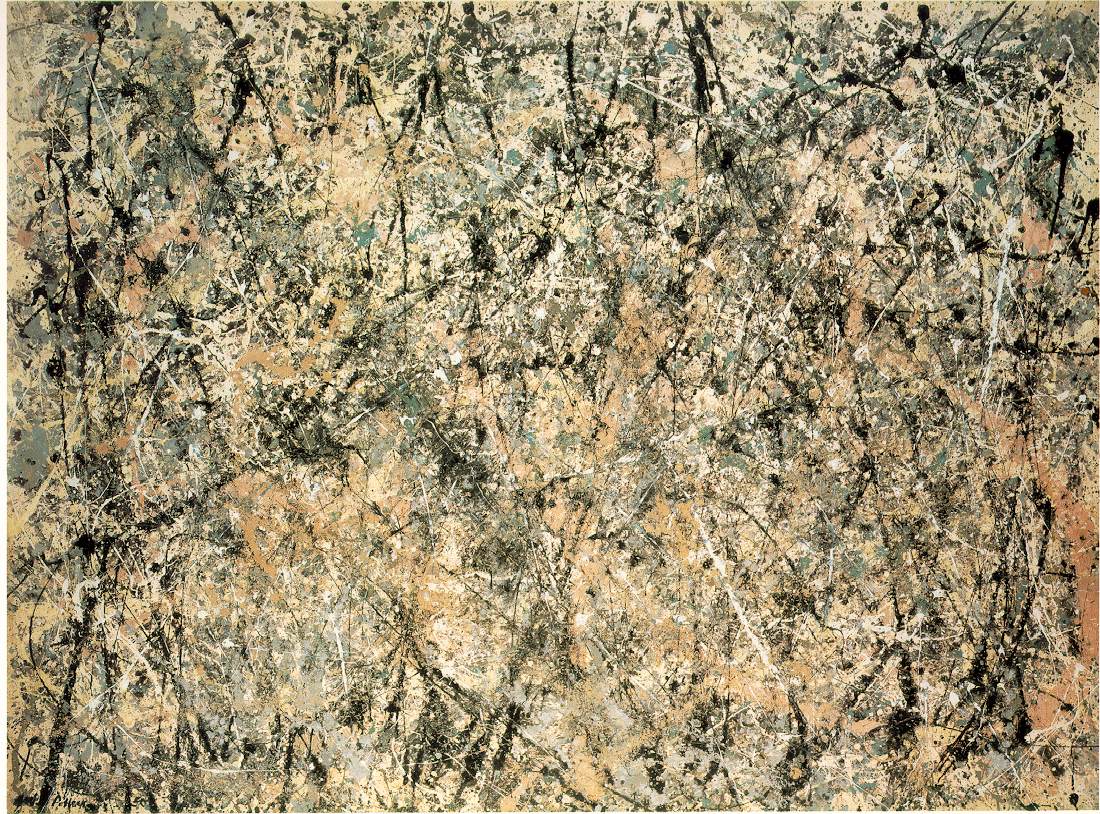
If the medium is the message, the artist is the transmitter. Take a look at the following Jackson Pollock quote found a on the Museum of Modern Art website:

 “When I am in my painting, I’m not aware of what I’m doing. It is only after a sort of ‘get acquainted’ period that I see what I have been about. I have no fear of making changes, destroying the image, etc., because the painting has a life of its own. I try to let it come through. It is only when I lose contact with the painting that the result is a mess. Otherwise there is pure harmony, an easy give and take, and the painting comes out well, (Musuem of Modern Art )."
Lavender Mist: Number 1, 1950 (Pollock)

The idea of being "in" the painting and it "taking on a life of its own" emphasizes the work as on objective entity.   Pollock's own words convey his role in the creative process, as one of a kind of conduit surrendering his own subjective will to this entity.  

In lecture, McLuhan describes the literate mind as being more objective due to its ability to make quick, yet informed decisions (McLuhan). Like the development of perspective, or Impressionism, each movement in art marked a new kind of literacy inside of the act of making art works. The literacy in Modernist art seeks to make decisive statements about art. 

This idea of decisive objectivity in art is juxtaposed with the inherent fluidity of art itself. The ability to adapt art to the purposes or interests of the practitioner, extend to the audience's ability to receive new approaches to traditional forms. Without this reception, the new ideas never grow.

Modernist Art is the result of the changes of cultural perspective of painting.  As Greenburg points out, Realism and Naturalism were central to the truth and value of the work, and served as vehicle to perpetuate the social and religious ideals (Greenburg).  Art continues to perform this function within our contemporary society but its message can be more fluid. New social messages are being transmitted through the medium of painting. 

With elitism no longer limiting the practice of painting, painting begins to mean many things to more people. The message of the medium changed.  I think this was important to the development of Modernist Art. Its reception depended on nurturing the seeds of social inclusion, accessibility, and literacy.
 

 Renaissance to Modern Portraiture


Girl with the Pearl Earring by Johannes Vermeer, 1665

Realism in Renaissance Art
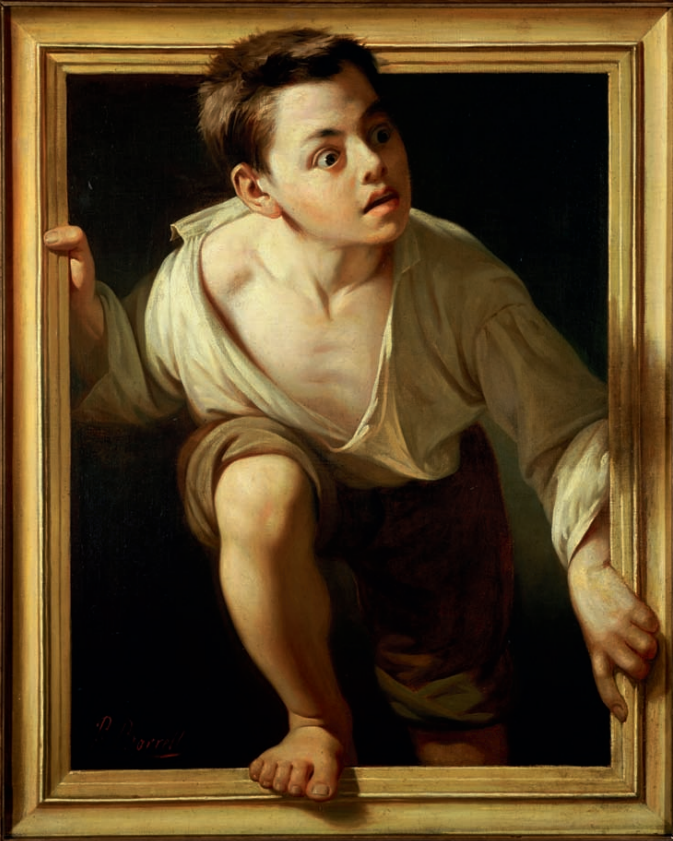
Escaping Criticism by Pere Borrell del Caso, 1874

The burgeoning concept of breaking boundaries in art is clear in both title and the subject of this painting.

Self-Portrait by
1899

The move away from the sculptural towards flatness.
Self-Portrait in a Striped T-Shirt by Henir Matisse, 1906
Self-Portrait in a Striped T-Shirt by Henri Matisse, 1906

The elements of colour line and perspective are deconstructed to emphasize the flatness of the canvas


Works Cited


Greenburg, Clement. "Greenburg: Modernism." 1960. University of Chicago. 23 September 2013 <http://www.sharecom.ca/greenberg/modernism.html>.

McLuhan, Marshall. "Marshall McLuhan Full lecture: The Medium is the Message." ABC National Radio: Monday Conference. Vol. 1. Comp. mywebcowtube. YouTube, 27 June 1977.

Pollock, Jackson. Lavender Mist: Number 1. National Gallery of Art. WebMuseum, Paris. Washington,, 2002.


Sunday, 22 September 2013

Finding Meaning in New Music


In art, I notice there is often a tension between the notion tradition and novelty. Artistic movements like Impressionism, Modernism and the Avant-Garde are responses to this tension.  Some might argue that Post-Modernism seeks to negotiate the conventional and contemporary.  This dialogue exists across disciplines and is communicated across mediums.  In Alex Ross’s article “Why do we hate modern classical music?” (2010) He tackles the issue in a discipline and musical genre that is often associated with the past.  The tenets of classical music (and Opera) are firmly rooted in tradition and history.  He laments the lack of acceptance or tolerance contemporary audiences seem to have for contemporary classical music.
Screenshot of  a "Guess the opera" post from the Facebook Group Page for
"Against Modern Opera Productions"
Exposure is a major factor to embracing new art forms. While I think the human brain is hardwired for simple tonality, it is merely a foundation for growth.  In his article, Mr. Ross fails to address that infants are exposed to many sounds in-utero, the most dominant being that of the mother's heartbeat. All internal bodily functions follow its steady rhythm with only variations in speed. It doesn't get much simpler than that.  As far as the infant's visual preference to representational images, it's a preference that functions as a foundation for further learning about the world visually. 

The fact is people rarely challenge themselves past, the familiar. I think this is why we reject new art forms, at least initially.  If it is not recognized, there can be no connection. The audience is alienated by the assumption that they should embrace something merely because it is new. They too expect, and expectation is a product of recollection. However, exploration through expression is what motivates most artistry.  The person who is concerned with exploration is far less fazed by the new. More poignant is how something new can relate to the old and still be fresh and progressive. People want art works to initiate a visceral response inside themselves that draws them in.  They want to be evoked, or exposed. It is up to the artist to express common points of reference to use these responses as pathways to connect with their audience.  I find this is what is missing from many contemporary music and art forms. Many contemporary artists are more concerned with showing a particular intellectual prowess, than making anyone feel anything. While I understand the overall tone of his article, I disagree with Mr. Ross' final statement that "What must fall away is the notion of classical music as a reliable conduit for consoling beauty – a kind of spa treatment for tired souls." This can be said for countless art forms.  So then, what must be said for art? The beauty lies in exploration, discovery, connection, and collaboration.  Once the work lacks any of these elements, it risks becoming superficial. Whether the subject is introspective and brooding, or light and ebullient, beauty brings us back to that place of childlike transparency where every experience not only informs of material existence, but advances our intellectual and emotional paradigms to help us navigate our relationships and create meaning.  

Works Cited
Ross, Alex. "Why do we hate modern classical music?" 28 November 2010. The Guardian. 18 September 2013 <http://www.theguardian.com/music/2010/nov/28/alex-ross-modern-classical-music>.